|
|
|
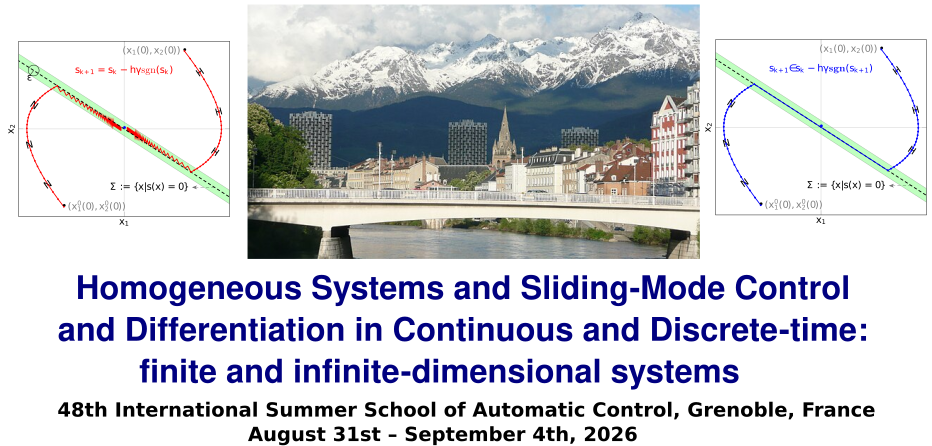
AimMotivation This school will focus on control, state observation, and differentiation by sliding modes, focussing on three main objectives: discrete-time systems, infinite-dimensional systems (EDP), and homogeneous systems. Sliding modes are one of the “classical” approaches to control engineering, and one of the most popular (as evidenced by the very high number of citations -7,500- of the famous article by V.I. Utkin published in 1977 in IEEE Trans. Aut. Contr.), introduced in the 1950s in Germany and the USSR. One of the major well-known obstacles to the implementation of sliding modes is the presence of high-frequency parasitic oscillations in the regulated output and in the control (bang-bang type signals), known as “chattering” or digital “jitter”. The application to the control of infinite-dimensional systems is also a difficult topic that remains largely open. However, this approach has recently experienced an unexpected revival with the introduction of new discrete-time algorithms (a fundamental aspect for applications and the treatment of the “chattering” phenomenon), homogeneity-based analysis (which allows finite-time stabilization to be addressed in a rigorous and broad framework for so-called high-order sliding modes), and the analysis of partial differential equation (PDE) control. Therefore, given the growing popularity of these three topics in control, it would be beneficial to offer an introductory course that would allow participants to take a feedback of their respective progress. This course would therefore focus on the emergence of recent topics in nonlinear control.
Organization The summer school will be made up of themed sessions, alternating presentations, questions and answers and exchanges, examples to work on, as well as practical sections. Time will be set aside for more informal exchanges on questions and points of view on current developments in this field. Audience The school is mainly intended for PhD students, researchers, and industrial participants. Basic knowledge in control theory, optimization, and mathematics is useful. About Grenoble Capital of the French Alps, Grenoble can be easily reached by plane from two airports: Lyon Saint-Exupery (LYS) or Geneva Cointrin (GVA Switzerland). From LYS, a bus shuttle reaches Grenoble's Railway Station in 1 hour. From GVA, a bus shuttle (2 hours) or a train is available. By train, frequent services are also available from Paris (3-hour TGV) and from Lyon (1 hour and 20 minutes by train).
|